


Lactic Acid Peels for Sensitive, Pigmented Skin
A clinician guide to lactic acid peel selection, dosing and PIH risk in dry, sensitive and Fitzpatrick IV–VI skin.

Lactic acid deserves a place in the skin-of-color peel armamentarium, but not because it is a risk-free “hydrating acid.” Its clinical value is more specific: it is a water-soluble alpha-hydroxy acid (AHA) with a larger molecular mass than glycolic acid, a useful record in superficial pigment protocols, and a tolerability profile that can suit selected dry or reactive phenotypes. At professional peel strength, however, it still produces a controlled chemical injury. Concentration, pH, free-acid availability, contact time and baseline barrier integrity determine whether that injury remains useful or becomes an inflammatory trigger for post-inflammatory hyperpigmentation (PIH).
The practical conclusion is not “lactic acid is safe for sensitive skin.” It is: lactic acid can be the more controllable AHA when the barrier is intact, the indication is epidermal, and the clinician doses it conservatively. Active dermatitis, retinoid irritation, fissuring or unexplained burning should prompt deferral, not substitution of glycolic with lactic acid.
Why lactic acid behaves differently from glycolic acid
Lactic and glycolic acids both reduce corneocyte cohesion and accelerate epidermal desquamation. Lactic acid has a molecular mass of about 90 Da, compared with approximately 76 Da for glycolic acid. That size difference is directionally useful: all else being equal, glycolic acid tends to enter the stratum corneum more readily. It does not create a universal potency ratio, because vehicle, pH, concentration and exposure can outweigh molecular size.
Lactate is also part of the skin's natural moisturising factor. In experimental work published in Archives of Dermatological Research, Rawlings and colleagues found that topical lactic-acid isomers increased stratum-corneum ceramides and improved barrier-function measures under the conditions studied. That supports the biological rationale for lactic acid in dry-skin formulations. It does not prove that a 60–90% professional peel is moisturising during the acute post-peel window. Low-concentration leave-on exposure and a short, high-free-acid procedural exposure are different interventions.
This distinction matters in Indian practice. A patient may describe skin as “dry” when the relevant finding is active irritant dermatitis from retinoids, scrubs, benzoyl peroxide or repeated salon exfoliation. The former may be a reasonable lactic-acid candidate; the latter needs barrier recovery first. Our pre-, intra- and post-peel barrier framework provides the broader readiness screen.

What the clinical evidence actually shows
The lactic-acid peel literature is useful but narrower than the marketing language built around it. Most studies address melasma, use small cohorts, and evaluate high concentrations under clinician supervision. They do not establish lactic acid as a universal peel for every sensitive or Fitzpatrick VI patient.
Indian studies show activity, not automatic superiority
A 2014 prospective study enrolled 20 patients with melasma and used 82% lactic acid over 12 weeks. All participants completed the study, pigment severity measures improved, and burning was the reported adverse effect. Without a comparator group and with a small sample, the study supports potential efficacy and tolerability but cannot tell us whether lactic acid was better than another peel or topical regimen.
A larger comparative study published in Dermatologic Therapy allocated 90 patients with epidermal melasma to 30% glycolic acid, 92% lactic acid or 15% trichloroacetic acid at two-week intervals for 12 weeks. Glycolic acid and TCA produced lower post-treatment MASI scores than lactic acid. This is a useful restraint on the claim that gentler automatically means equally effective.
The most current Indian randomized comparison, published in the Indian Journal of Dermatology in 2025, enrolled 40 adults with melasma in Central India. Participants received four fortnightly sessions of either 80% lactic acid or 50% glycolic acid. Thirty-four completed the study. Median MASI reduction was greater with glycolic acid, while the reported side-effect profiles were not statistically different. This does not make lactic acid ineffective; it shows the likely trade-off: a clinician may accept a slower pigment response when exposure control or tolerability is the higher priority.
Skin-of-color reviews expose the evidence gap
A review of chemical peels for melasma in darker skin noted encouraging early lactic-acid studies, including improvement in a small pilot and performance comparable with Jessner's solution in a split-face study. The authors also emphasized that the available cohorts did not adequately answer how the agent performs across the full range of ethnic skin. Fitzpatrick IV–VI should therefore not be treated as a single evidence-rich group.
For a patient with melasma, a peel is also an adjunct rather than the complete treatment. Photoprotection, trigger control and an appropriate melanogenesis strategy determine recurrence and PIH risk. A “hydrating peel” cannot compensate for poor light protection or an inflammatory home regimen. See the procedural role of sunscreen in Indian skin and the broader skin-of-color brightening formulary.
Candidate selection: dry phenotype is not damaged barrier
The best lactic-acid candidate is not simply “anyone who stings with glycolic.” First determine why the patient stings. Constitutional dryness, low sebum and rough texture can coexist with a clinically quiet barrier. By contrast, burning with water, active scale, fissures, excoriations, dermatitis, a rosacea flare or recent procedural injury indicate unstable permeability and inflammation.
| Clinical presentation | Lactic-acid decision | Rationale in Fitzpatrick IV–VI |
|---|---|---|
| Stable dry skin, no burning or active scale | Consider a conservative superficial protocol | Lower inflammatory burden is valuable when the indication is epidermal |
| Dry skin plus epidermal dyschromia | Consider as an adjunct after diagnosis and priming | Expect gradual pigment change; do not chase a dramatic endpoint |
| First professional AHA exposure | Start with the lower validated protocol, shorter contact and close review | Previous tolerance is more informative than phototype alone |
| Active eczema, irritant dermatitis or sunburn | Defer | Abnormal penetration and inflammation increase PIH risk |
| Retinoid-induced burning or peeling | Hold the irritant and restore comfort before reassessment | Lactic acid does not neutralize pre-existing barrier injury |
| Mixed or dermal melasma | Do not escalate solely for limited response | Deeper pigment is unlikely to justify a deeper inflammatory injury |
| History of prolonged PIH after minor trauma | Patch or test-area strategy; widen intervals | Melanocyte reactivity may outweigh the theoretical tolerability advantage |
| FST VI with limited prior peel history | Use the most conservative feasible entry and rigorous follow-up | Direct high-quality lactic-peel data in FST VI remain limited |
Patient selection should also screen for active infection, herpes history, isotretinoin or other relevant medication exposure, pregnancy considerations, abnormal scarring, recent waxing or depilation, and realistic aftercare adherence. Follow the clinic's medical protocol and current local guidance; a blog table is not a substitute for assessment.
Dose the peel, not the percentage on the label
A 60% lactic acid and an 80% lactic acid product are not simply “gentle” and “strong.” The effective dose depends on acid concentration, pH, free-acid fraction, solvent, viscosity, application volume, number of passes, degreasing, contact time, anatomy and temperature. Two products bearing the same percentage can behave differently. The same formulation can also penetrate unevenly across an over-degreased cheek, an oily nose and an excoriated jawline.
This is the same principle discussed in our guide to concentration, pH and free-acid value in glycolic peels: percentage is one variable, not the dose by itself.
A conservative escalation framework
- Establish a calm baseline. Document dryness, symptoms, active products, recent procedures, prior PIH and baseline photographs under consistent light.
- Choose the lower-intensity validated protocol. For a new, dry or pigment-reactive patient, start with the lower product-specific exposure rather than planning to “treat to redness.”
- Standardize preparation. Cleanse and degrease uniformly without abrasion. Do not compensate for uneven preparation with more acid.
- Time every exposure. Record concentration, product, passes, contact time, symptoms, endpoint and neutralisation. Memory is not a protocol.
- Escalate one variable at a time. Increase concentration, time or number of passes—not all three in one session.
- Let recovery determine cadence. Persistent burning, delayed scale, new PIH or prolonged tightness means step back, not repeat on schedule.
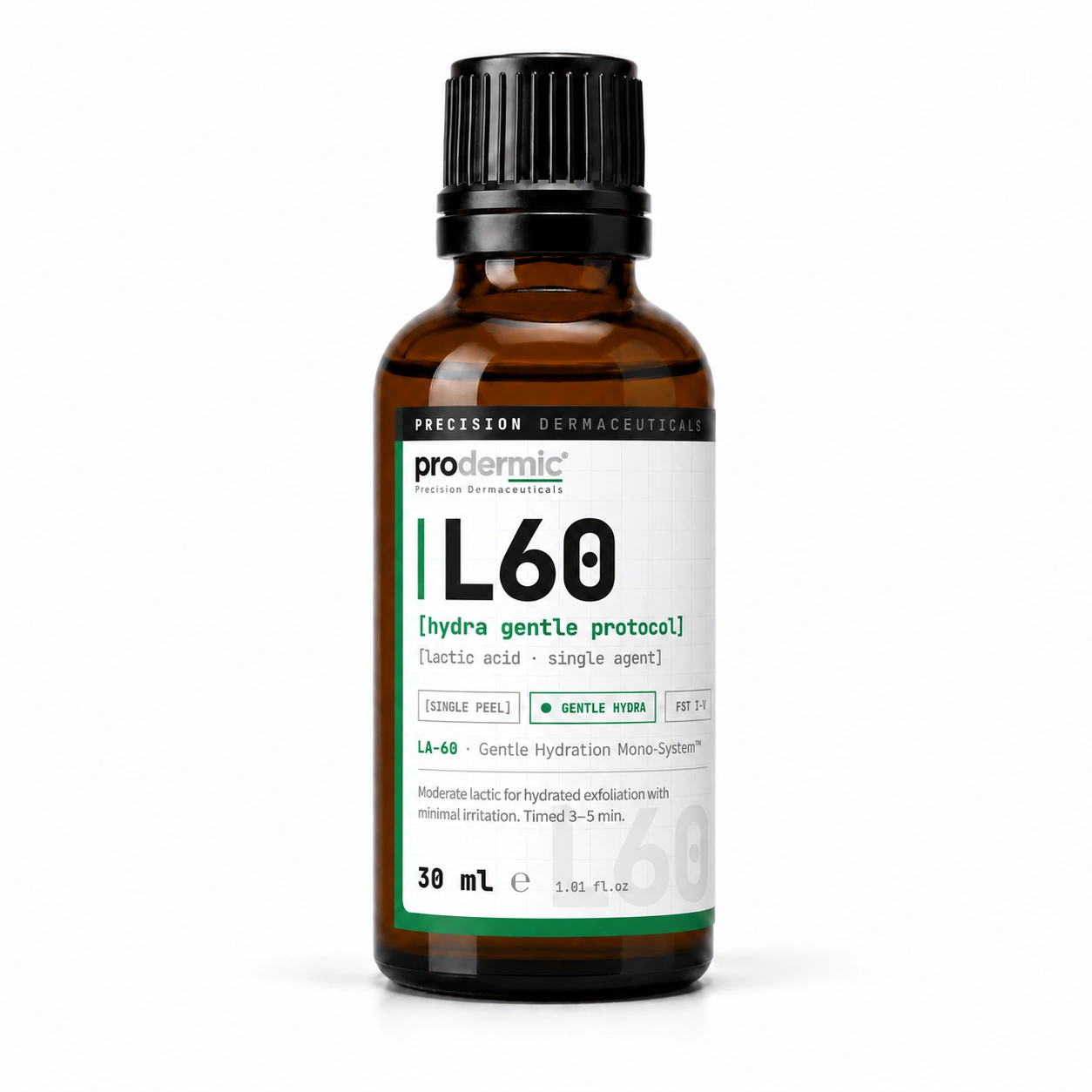
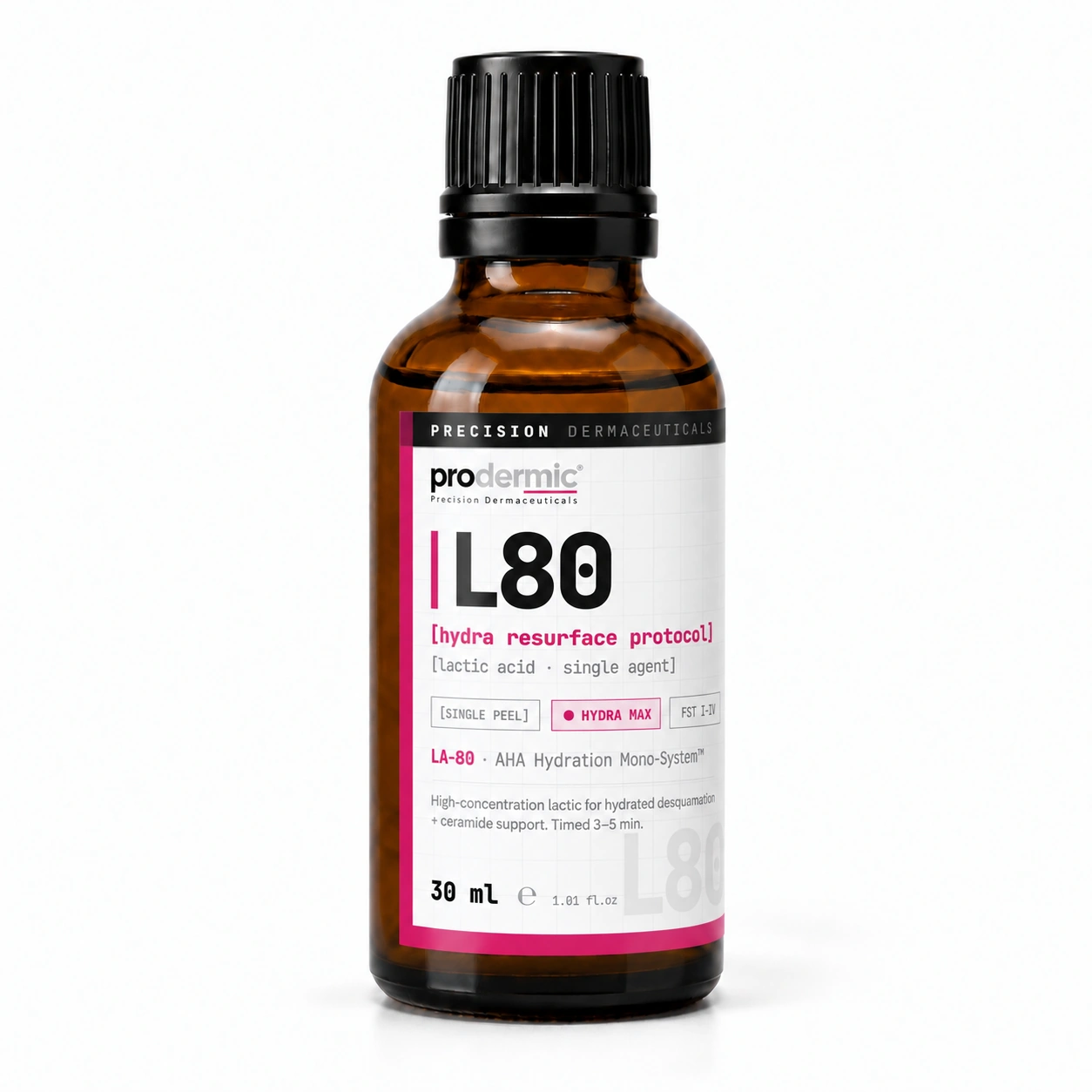
For clinics using the verified Prodermic catalog, L60 Lactic Peel is the moderate-strength single-agent option and L80 Lactic Peel is the higher-strength step. Both are professional timed protocols and both require product-specific technique and neutralisation. The clinically defensible pathway is L60 to assess response, with L80 reserved for a demonstrated need and demonstrated tolerance—not an automatic second appointment.
When a combination peel is the better tool
A single-agent lactic peel is most coherent when hydration-focused superficial resurfacing is the principal procedural goal. It is less complete when the main problem is active acne, significant comedonal disease, resistant melasma or mixed-pathway PIH. In those cases, another acid or a conservative combination may match the biology better.
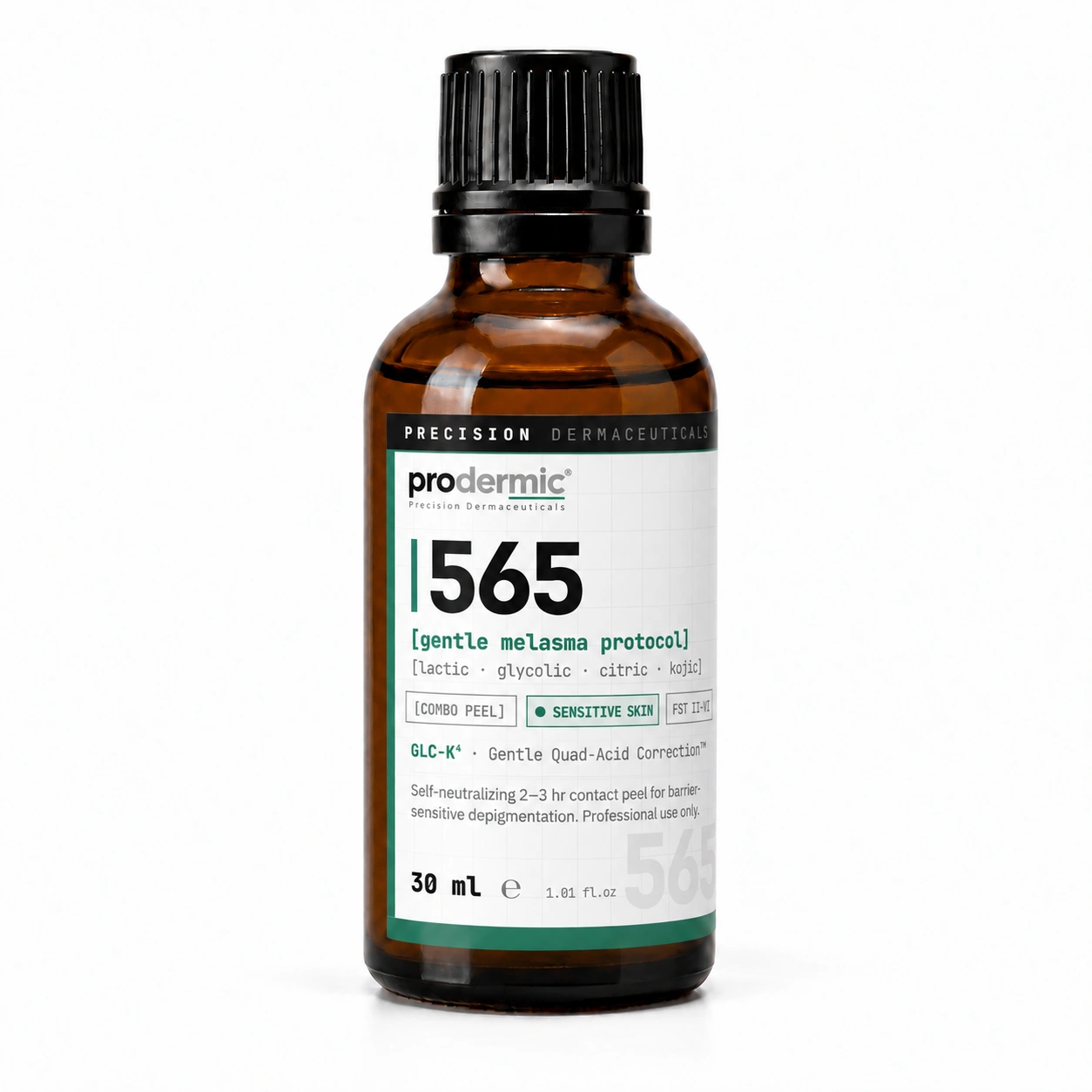
Melasmonil 565, for example, contains 15% lactic acid alongside lower-concentration glycolic and citric acids plus kojic acid. Its role is not “lactic acid, only safer”; it is a multi-agent depigmentation option for selected sensitive or first-peel pigment patients. The clinician still has to screen the barrier and total irritant load. For acne-dominant oily skin, a lipophilic salicylic- or mandelic-led strategy may be more logical. The acid-selection guide by Fitzpatrick type separates these phenotypes.
Avoid stacking a professional lactic peel with multiple home AHAs, retinoids, scrubs or benzoyl peroxide simply because each item is individually familiar. Cumulative irritation is often the mechanism that converts a technically superficial protocol into PIH.
Procedure-day and recovery safeguards
The procedural objective is a uniform superficial exposure, not maximal sensation. Confirm that the skin is quiet on the day; remove makeup and surface oil without scrubbing; protect vulnerable creases and mucocutaneous junctions; apply systematically; monitor discomfort and surface change; and neutralise or rinse exactly as the formulation requires.
For FST IV–VI, the endpoint should remain conservative. Burning that accelerates, patchy whitening, marked oedema or an unexpectedly intense reaction requires immediate termination and reassessment. “No frost” does not mean “no effect,” and “more peeling” is not a validated proxy for a better pigment result.
Recovery should be deliberately low-variable:
- use a mild cleanser and a bland moisturising plan;
- avoid picking, friction, waxing, threading, scrubs and exfoliating devices;
- hold retinoids and exfoliating acids until desquamation and stinging have resolved;
- use broad-spectrum photoprotection and reduce avoidable heat and visible-light exposure;
- provide rapid review instructions for disproportionate pain, blistering, crust, discharge, herpes-like vesicles or emerging pigment change.
REST.01 Recovery Balm can serve as a supportive emollient step after an appropriate peel. It should not be positioned as a guarantee against PIH or as treatment for a complication. If pigment darkening appears, stop procedural escalation and use the structured approach in our post-peel PIH checklist for Indian skin.
A chairside decision framework
Use four questions before choosing lactic acid:
- Is the barrier clinically quiet? If not, defer and diagnose.
- Is the target epidermal and suitable for a superficial peel? If not, changing the acid may not solve the mismatch.
- Is lower inflammatory burden more important than maximal speed? If yes, lactic acid may be a rational AHA choice.
- Can the patient adhere to recovery and photoprotection? If not, PIH risk may outweigh procedural benefit.
That framework makes lactic acid a deliberate selection rather than a catch-all “sensitive skin” label. It also sets expectations honestly: the available melasma comparisons suggest that glycolic acid can improve pigment scores more quickly or to a greater degree in some cohorts, while lactic acid may remain valuable when a controlled, hydration-compatible AHA strategy is preferred.
Key Takeaways
- Lactic acid is a rational AHA for selected dry, sensitive and pigment-prone phenotypes, but it is not intrinsically barrier-safe at professional peel strength.
- Separate low-concentration hydration and ceramide data from evidence on 60–90% clinician-administered peels.
- Indian comparative trials show lactic acid can improve melasma, while glycolic acid may produce greater MASI reduction in some cohorts; tolerability and efficacy must be balanced.
- In Fitzpatrick IV–VI, intact-barrier screening, conservative endpoints, one-variable-at-a-time escalation and photoprotection are the core PIH controls.
- Choose single-agent lactic acid when controlled superficial resurfacing is the goal; choose other acids or combinations when acne, resistant pigment or deeper targets demand different biology.
Frequently asked questions
Is lactic acid peel safe for Fitzpatrick IV–VI skin?
It can be used conservatively in selected patients, but “safe” is conditional. Published data support superficial lactic-acid use in pigment disorders, yet direct evidence across FST V–VI is limited. Barrier integrity, formulation, exposure, technique, PIH history and aftercare are more useful than phototype alone.
Is an 80% lactic acid peel gentler than a 50% glycolic acid peel?
Not by percentage alone. Lactic acid is larger than glycolic acid, but pH, free-acid fraction, vehicle and contact time determine effective exposure. In a 2025 randomized Indian melasma trial, 50% glycolic acid produced a greater median MASI reduction than 80% lactic acid, with no statistically significant difference in reported side-effect profiles.
Can lactic acid be used on a damaged skin barrier?
No professional peel should be used to “repair” active barrier damage. Treat dermatitis, retinoid irritation, fissuring, infection or sunburn first. Lactic acid's humectant biology does not cancel the chemical injury of a peel-strength exposure.
How often should lactic acid peels be performed?
Published melasma studies often used two-week intervals, but that is not a universal prescription. Cadence should follow the specific product protocol, depth, indication and observed recovery. Delay or de-escalate when stinging, scale, tightness or pigment persists.
Does lactic acid treat melasma by itself?
It may improve epidermal melasma as an adjunct, but melasma is chronic and multifactorial. Photoprotection, trigger management and an appropriate topical maintenance plan remain central. Deeper or mixed pigment should not be chased with progressively aggressive peels.
References
- 80% Lactic Acid Peel Versus 50% Glycolic Acid Peel for Melasma: A Randomised Clinical Trial
- Effect of 82% Lactic Acid in Treatment of Melasma
- Most worthwhile superficial chemical peel for melasma of skin of color
- Chemical Peels for Melasma in Dark-Skinned Patients
- Effect of lactic acid isomers on ceramide synthesis and barrier function
- Standard guidelines of care for chemical peels
- Alpha hydroxy acid facial treatments
Related Protocols
~20 sessions
~20 sessions
~24 sessions
~25 sessions