


Hyaluronic Acid After Peels: A Recovery Guide
A clinician guide to hyaluronic acid after chemical peels: evidence, molecular weight, formulation choice and recovery timing in skin of color.

Topical hyaluronic acid (HA) can be useful after a chemical peel, but its job is narrower than “healing” marketing suggests. It is primarily a humectant and film-former: it helps hold water at and within the stratum corneum, can improve the feel of tight skin, and may support a low-friction recovery environment. It does not neutralise residual acid, replace an emollient or occlusive, treat infection, prevent post-inflammatory hyperpigmentation (PIH) by itself, or convert an excessive-depth peel into a controlled injury.
For dermatologists and trained aestheticians, the practical question is therefore not simply whether HA is “safe after a peel.” The useful questions are: how deep was the peel, is the surface intact, what else is in the formula, which molecular-weight claims are clinically meaningful, and what must accompany the humectant? In Fitzpatrick IV–VI skin, those decisions matter because persistent irritation and delayed re-epithelialisation can extend inflammatory signalling and increase pigment risk.
Start with the evidence boundary
Direct trials of an ordinary topical HA serum after chemical peeling are limited. Most relevant evidence comes from three neighbouring domains: topical hydration studies on intact xerotic skin, mechanistic work on HA and wound biology, and post-procedure studies after devices such as fractional laser. Those domains support biological plausibility and formulation logic, but they are not interchangeable with a superficial glycolic peel, a layered Jessner–TCA procedure or a focal complication.
A 2024 double-blind randomised trial from the University of Indonesia compared low-molecular-weight HA (LMW-HA), high-molecular-weight HA (HMW-HA) and vehicle moisturisers on separate leg sites in 36 older adults with xerosis. After four weeks, the LMW-HA site had higher capacitance—a hydration measure—than the HMW-HA and vehicle sites. There were no significant between-group differences in transepidermal water loss (TEWL) or symptom scores. This is evidence for hydration in dry, intact skin; it is not proof of faster healing after a peel.
The most procedure-specific trial located was a 2025 prospective randomised study of 60 patients after ablative fractional CO2 laser. A regimen containing multiple HA molecular sizes was associated with lower day-14 TEWL, less measured erythema at several time points and shorter reported pain duration than control care. That result is encouraging, but the intervention was a complete skincare regimen after laser—not isolated HA after a chemical peel. Differences in injury geometry, depth, vehicle and co-ingredients prevent a direct efficacy claim.
A 2025 expert consensus on periprocedural skincare states that HA may be used with bland skincare immediately after chemical peels. Its evidence level is expert opinion rather than a peel-specific randomised trial. The defensible conclusion is modest: a well-tolerated HA-containing product can be included in clinician-directed aftercare, especially after a superficial peel, but the complete vehicle and recovery plan are more important than the HA label alone.
What topical HA actually does
HA is a glycosaminoglycan composed of repeating disaccharide units. Endogenous HA participates in extracellular-matrix organisation, tissue hydration and wound signalling. Topically applied cosmetic HA is not equivalent to the HA already present in viable epidermis and dermis, and it should not be discussed as though a surface serum replenishes the dermal matrix.
The immediate value of topical HA is physical. Its hydrophilic polymer chains associate with water and form a hydrated film. HMW-HA tends to remain near the surface; lower molecular sizes may enter the stratum corneum more readily. A Raman spectroscopy study on human skin sections found that 20–300 kDa HA crossed the stratum corneum under the test conditions, whereas 1,000–1,400 kDa HA did not. A later tape-stripping study detected increased HA in stratum-corneum layers after repeated application of a mixed-size formulation. Neither study establishes meaningful dermal delivery from a routine post-peel serum.
This surface action can still be clinically useful. A comfortable, hydrated surface is less likely to invite rubbing, picking and repeated product application. Reduced mechanical interference matters when the treatment goal is predictable re-epithelialisation. But HA is a humectant, not a complete barrier-repair system. A watery serum without lipids, emollients or an occlusive layer may feel tight after it dries, particularly in air-conditioned clinics, dry weather or when the barrier is already permeable.

Molecular weight is not a simple better-versus-worse ladder
HA molecular weight affects viscosity, residence at the surface, penetration and biological behaviour. It does not yield a universal rule that “smaller penetrates, therefore smaller heals better.” Product labels also use inconsistent categories—“ultra-low,” “low,” “medium” and “high” may not disclose an actual kilodalton range—and the vehicle can alter delivery.
| Formulation claim | Most defensible interpretation | Post-peel caution |
|---|---|---|
| High-molecular-weight HA | Primarily surface film formation and water retention | Surface residence can be useful; lack of deep penetration is not failure |
| Low-molecular-weight HA | Greater potential for stratum-corneum entry than HMW-HA | More penetration does not automatically mean better tolerance or faster recovery |
| Multi-molecular or multi-weight HA | Attempts to combine surface film with upper-barrier hydration | Judge the whole formula and supporting trial, not the number of HA sizes |
| Hydrolysed HA or sodium hyaluronate | Processed or salt forms whose behaviour depends on size and vehicle | The ingredient name alone does not reveal molecular weight or clinical performance |
| Crosslinked HA | A modified network designed for longer residence or different rheology | Do not confuse topical crosslinked HA with injectable HA filler |
Mechanistic reviews of dermal wound healing also show why the “smaller is always better” story is incomplete. HMW-HA is generally associated with homeostatic and anti-inflammatory signalling, whereas smaller fragments produced during tissue injury can participate in inflammatory and angiogenic signalling. Much of this literature concerns endogenous fragments, cell systems, animal wounds or specialised biomaterials—not routine leave-on cosmetics. It should inform scientific restraint, not prompt clinicians to classify every LMW-HA serum as pro-inflammatory.
The clinic should ask suppliers for the actual molecular-weight distribution, complete ingredient list, preservative system, pH, patch-testing or tolerance data, and any study performed on the finished formulation. A polymer-size graphic without finished-product evidence is a formulation story, not a recovery outcome.
HA does not replace barrier care
After a peel, water is lost through a temporarily more permeable surface. A humectant can increase water within the stratum corneum, while emollients improve surface flexibility and occlusives reduce evaporation. These functions overlap but are not identical. A sensible regimen often uses them together.
This is the central connection to our broader skin-barrier framework around chemical peels. The peel itself determines the injury; aftercare protects the recovery conditions. For a superficial, evenly neutralised peel on intact skin, an HA-containing bland moisturiser may be sufficient if it also supplies emollient or occlusive support. For more dryness, a separate recovery balm can be layered over a tolerated humectant. For medium-depth injury, erosions or blistering, the clinician's wound-care protocol takes priority over cosmetic layering.
The REST.01 Recovery Balm protocol illustrates the complementary role: its catalogue formula uses aloe, urea, shea butter, jojoba oil and vitamin E rather than HA. That is not a deficiency. A lipid-rich or occlusive recovery product answers a different question—limiting moisture escape and improving surface flexibility—than an HA serum does.
A phase-based post-peel decision framework
The following framework is deliberately conservative. Product-specific instructions, peel depth, anatomy, comorbid dermatoses and the treating dermatologist's protocol remain authoritative.
| Recovery phase | Clinical findings | Role for HA | What should not be restarted merely because HA is tolerated |
|---|---|---|---|
| Immediate, after a superficial peel | Uniform erythema or tightness; intact surface; peel fully removed or neutralised as required | A minimal, fragrance-free HA-containing bland moisturiser may be used if previously tolerated | Retinoids, exfoliating acids, scrubs, benzoyl peroxide or fragranced actives |
| First 24–72 hours | Dryness or fine scaling without escalating pain, oedema or erosion | Apply to slightly damp—not wet or macerated—skin, then seal with a bland emollient/occlusive if needed | High-strength antioxidant or pigment serums solely because they also contain HA |
| Days 3–7 after a superficial peel | Settling erythema, controlled desquamation, comfortable cleansing | Continue only if it reduces tightness without stinging; simplify if pilling encourages rubbing | Picking scale, cleansing brushes, waxing or unsupervised exfoliation |
| After re-epithelialisation and symptom resolution | No raw areas, fissures, persistent burning or unexpected erythema | Transition from recovery hydration to the indication-specific maintenance plan | Automatic return to every pre-peel active on the same day |
| Medium-depth peel or non-intact surface | Oedema, crusting, erosions or clinician-defined wound care | Use only the specified dressing or topical regimen; HA is optional, not foundational | Over-the-counter serum experimentation or multiple layered products |
For Fitzpatrick IV–VI skin, the threshold for simplifying care should be low. Stinging is not proof that a product is “working.” Persistent erythema may be less visually obvious in deeply pigmented skin, so assess warmth, tenderness, oedema, sheen, fissuring and symptom trajectory rather than colour alone. If irritation increases after adding a product, stop the new exposure and reassess; do not cover the reaction with more layers.
Photoprotection remains the more direct pigment-control intervention once the clinician judges sunscreen appropriate for the recovery stage. The evidence and visible-light considerations are detailed in sunscreen as a procedural adjunct in Indian skin. HA does not absorb ultraviolet or visible light and should never be described as a substitute for sunscreen.
Formulation triage: evaluate the bottle, not the hero ingredient
An “HA serum” may contain fragrance, essential oils, denatured alcohol, exfoliating acids, retinoids, high-strength vitamin C, botanical mixtures or film-formers that pill. The safest choice is not necessarily the product with the longest ingredient list or the most molecular weights.
Prefer during the early recovery window
- A short, fully disclosed ingredient list with a well-characterised preservative system.
- No fragrance or essential oils and no exfoliating acid blend.
- A vehicle that spreads with minimal rubbing and does not dry into a brittle film.
- Appropriate emollient or occlusive support, either within the formula or layered as directed.
- Packaging that limits contamination; avoid repeatedly dipping fingers into a shared clinic jar.
- Previous tolerance when possible, especially in patients with eczema, rosacea, contact allergy or multiple product reactions.
Delay or individualise
- HA combined with retinol, glycolic acid, salicylic acid or other resurfacing agents.
- Strongly acidic antioxidant formulas that sting on newly peeled skin.
- Brightening combinations selected for long-term pigment control rather than immediate recovery.
- Multiple new products introduced simultaneously, which make a reaction difficult to attribute.
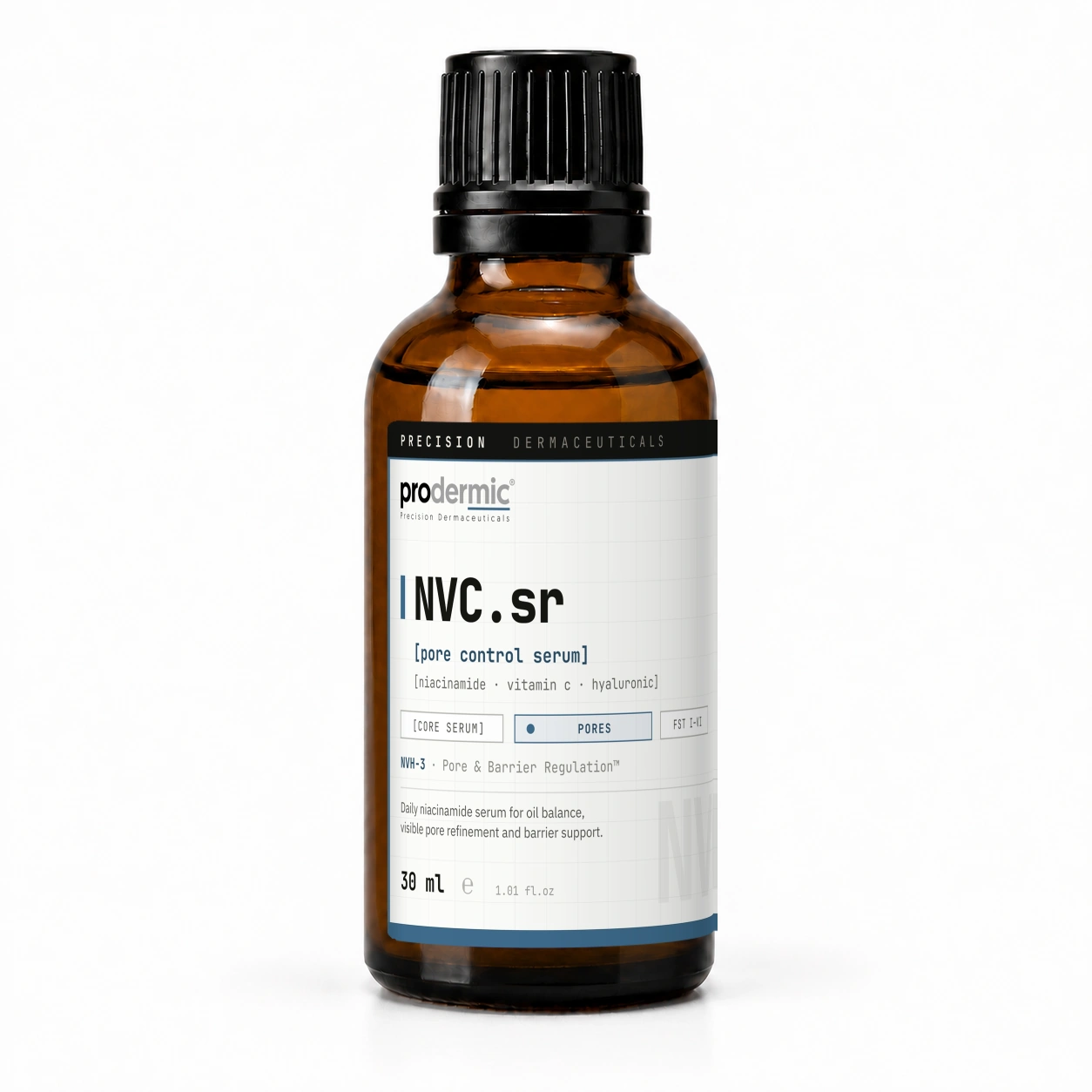
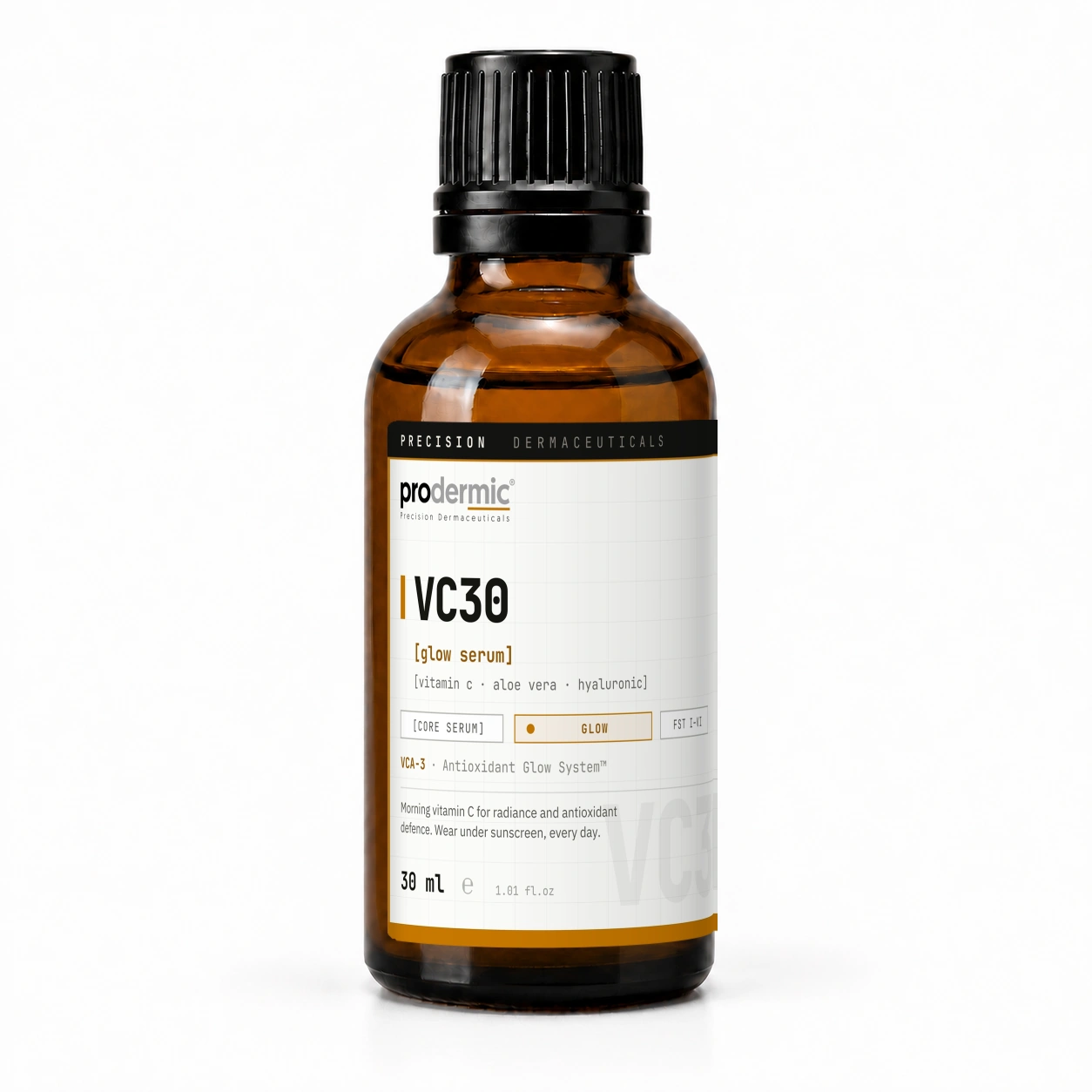
The Prodermic catalogue includes HA within the NVC.sr Niacinamide Serum and VC30 Glow Serum. Their additional actives—not HA—determine timing. NVC.sr combines HA with niacinamide and vitamin C; VC30 contains 30% vitamin C, aloe and 1% HA. Neither should be treated as a bland HA-only serum. Follow the product protocol and clinical tolerance, and delay a high-strength antioxidant formula until the barrier is ready rather than using it immediately because HA appears on the label.
That distinction also prevents a common counselling error: “contains HA” is not a post-procedure clearance category. The retinoid pre- and post-peel guide makes the same timing point for combination products—one hydrating co-ingredient does not cancel the irritation potential of the active that drives the formula.
What HA does not do
HA does not correct an inadequate neutralisation step. It does not sterilise the skin, treat herpes reactivation or bacterial infection, reverse chemical injury, remove crusts, or justify deeper peeling. It is not a melanogenesis inhibitor and does not independently prevent PIH. It cannot replace diagnosis when “post-peel dryness” is actually irritant contact dermatitis, allergic contact dermatitis, infection or an unexpectedly deep injury.
It also does not establish readiness for the next session. A surface that feels temporarily plump after serum application may still have increased permeability or ongoing inflammation. Re-treat according to clinical recovery, not cosmetic feel. This is particularly important when using stronger peels or when the previous session produced prolonged erythema, erosions or pigment alteration.
Escalate assessment for increasing rather than settling pain, marked oedema, vesicles, pustules, honey-coloured crust, sharply demarcated dermatitis, grey or dusky areas, spreading tenderness, ocular symptoms, fever, or new pigment change accompanied by inflammation. Patients should be instructed whom to contact and should not be asked to self-manage these signs with another serum.
Key Takeaways
- Keep the claim narrow. Topical HA supports surface and stratum-corneum hydration; direct evidence after chemical peels is limited.
- Assess the finished formulation. Molecular weight matters, but vehicle, co-actives, fragrance, preservatives and tolerability determine whether a product belongs in early aftercare.
- Pair functions deliberately. A humectant does not replace emollient, occlusive, dressing, photoprotection or clinician-directed wound care.
- Time combination serums by their active load. HA does not make retinoids, acids or high-strength vitamin C suitable for immediate post-peel use.
- Use a lower irritation threshold in Fitzpatrick IV–VI. Persistent symptoms, friction and prolonged inflammation deserve early review because they can precede PIH.
- Escalate complications. Increasing pain, oedema, erosion, crusting, vesicles or spreading inflammation require assessment—not more hydration layers.
Frequently asked questions
Can hyaluronic acid be applied immediately after every chemical peel?
No. It may be reasonable after a superficial, properly completed peel when the surface is intact and the finished formula is bland and previously tolerated. Medium-depth peels, erosions, blistering or a prescribed dressing protocol require clinician-directed wound care. “HA” on the label does not override peel depth or the other ingredients.
Should HA be applied to damp skin after a peel?
A small amount of residual moisture can help a humectant spread, but soaking or macerating a compromised surface is not the objective. Pat gently as directed, avoid friction, and apply the prescribed emollient or occlusive layer if the HA formula does not provide one. Technique should be adapted to the depth and wound-care plan.
Is low-molecular-weight HA better after peels?
Not categorically. Lower molecular sizes can enter the stratum corneum more readily, and one xerosis trial found greater capacitance with LMW-HA than HMW-HA. However, post-peel benefit depends on the full formula, barrier state and procedure. HMW-HA surface film formation may itself be useful. There is no robust peel-specific evidence that the smallest available HA produces the best recovery.
Can HA prevent post-peel PIH in Fitzpatrick IV–VI skin?
There is no good evidence that HA directly prevents PIH. Comfortable hydration may reduce secondary irritation and picking, but pigment risk is managed through appropriate peel selection and depth, controlled inflammation, careful aftercare and photoprotection. If PIH occurs, use a diagnosis-led plan such as the framework in managing post-peel PIH in Indian skin.
Is an HA serum enough without a moisturiser?
Often not during recovery. HA is chiefly a humectant and film-former. Dry, air-conditioned or highly permeable skin may need an emollient or occlusive to reduce water loss and improve flexibility. Choose the combination by clinical findings and peel depth rather than assuming that every serum needs the same “seal.”
References
- Effectiveness of topical hyaluronic acid of different molecular weights in xerosis cutis treatment
- Multi-molecular hyaluronic acid for recovery after ablative fractional CO2 laser
- Immunologic Roles of Hyaluronan in Dermal Wound Healing
- Human skin penetration of hyaluronic acid of different molecular weights
- Hyaluronic acid skin penetration evaluated by tape stripping
- A Guide to Periprocedural Skin Care Regimen
- Standard guidelines of care for chemical peels
- Chemical peels: FAQs — American Academy of Dermatology
Related Protocols
~25 sessions
~75 sessions
~75 sessions